Why Does Dandruff Keep Coming Back? The Role of Malassezia and Seborrheic Dermatitis
For some people, dandruff appears occasionally and then disappears. For others, it seems to follow a frustrating cycle.
The flakes improve, the scalp looks clearer, and then a few weeks later the itching and scaling return.
If this sounds familiar, you may wonder why dandruff keeps coming back.
The answer may involve more than simply how often you wash your hair. The scalp environment, natural oils, Malassezia yeast, the skin barrier and inflammation can all play a role.
Why Does the Scalp Produce Oil?
Your scalp contains sebaceous glands that produce sebum, a natural oil that helps maintain the skin.
Sebum is a normal and necessary part of healthy skin. However, the scalp is also an environment where oil-loving microorganisms such as Malassezia naturally live.
This creates a relationship between scalp oil, microorganisms and the condition of the skin.
Having an oily scalp does not automatically mean you will develop dandruff or seborrheic dermatitis. Individual susceptibility is an important part of the picture.
Malassezia and the Scalp
Malassezia is a naturally occurring yeast found on the skin of most adults.
It is particularly associated with oily areas because it relies on lipids from the skin environment.
For most people, this causes no noticeable problems.
In susceptible individuals, however, the interaction between Malassezia and the scalp may contribute to irritation, scaling and inflammation.
This is one of the reasons Malassezia is frequently discussed when explaining dandruff and seborrheic dermatitis.
Why Can Symptoms Keep Returning?
Seborrheic dermatitis is generally a recurring condition.
This means that improving your symptoms does not necessarily mean the underlying tendency has permanently disappeared.
A person can have a period where their scalp looks healthy and relatively clear before experiencing another flare.
Various factors may influence these changes, including environmental conditions, stress, scalp oil, skin-barrier function and individual susceptibility.
The presence of Malassezia is also only one piece of the puzzle.
Does an Oily Scalp Cause Seborrheic Dermatitis?
Not necessarily.
It is tempting to assume that excess oil automatically causes dandruff or seborrheic dermatitis, but the relationship is more complicated.
Seborrheic dermatitis commonly affects oily areas because these areas provide an environment where Malassezia thrives. However, oil production alone does not determine whether someone develops the condition.
Two people can have similarly oily scalps while only one experiences persistent inflammation and scaling.
Individual skin sensitivity and the way the immune system responds to the scalp environment also matter.
Why Do Anti-Dandruff Products Help?
Many anti-dandruff products contain ingredients designed to address one or more factors involved in dandruff.
Some active ingredients have antifungal properties and can help reduce Malassezia activity on the scalp. Others help loosen or control excess scale.
For people whose symptoms are connected to seborrheic dermatitis, controlling Malassezia can be an important part of reducing recurring symptoms.
However, seborrheic dermatitis also involves inflammation, meaning controlling yeast activity is not necessarily the entire solution for every person.
What If Your Shampoo Stops Working?
Some people find that a dandruff shampoo works well initially but becomes less effective over time.
There are several possible explanations.
The scalp condition may have changed, the symptoms may require a different approach, or the original problem may not have been dandruff or seborrheic dermatitis in the first place.
Other scalp conditions can resemble seborrheic dermatitis, including psoriasis and eczema.
If symptoms continue despite an appropriate scalp-care routine, it is worth considering whether something else may be contributing.
Should You Wash Your Hair More Often?
More washing is not automatically better.
Seborrheic dermatitis is not caused by having a dirty scalp, and aggressive washing or scrubbing can irritate already-sensitive skin.
At the same time, keeping the scalp appropriately clean can help control oil, scale and product build-up.
The ideal routine depends on your scalp, hair type, symptoms and the products you are using.
The goal should be a consistent routine that keeps the scalp comfortable without unnecessarily irritating it.
The Connection Between Dandruff and Seborrheic Dermatitis
Recurring dandruff can sometimes be part of the wider spectrum of seborrheic dermatitis.
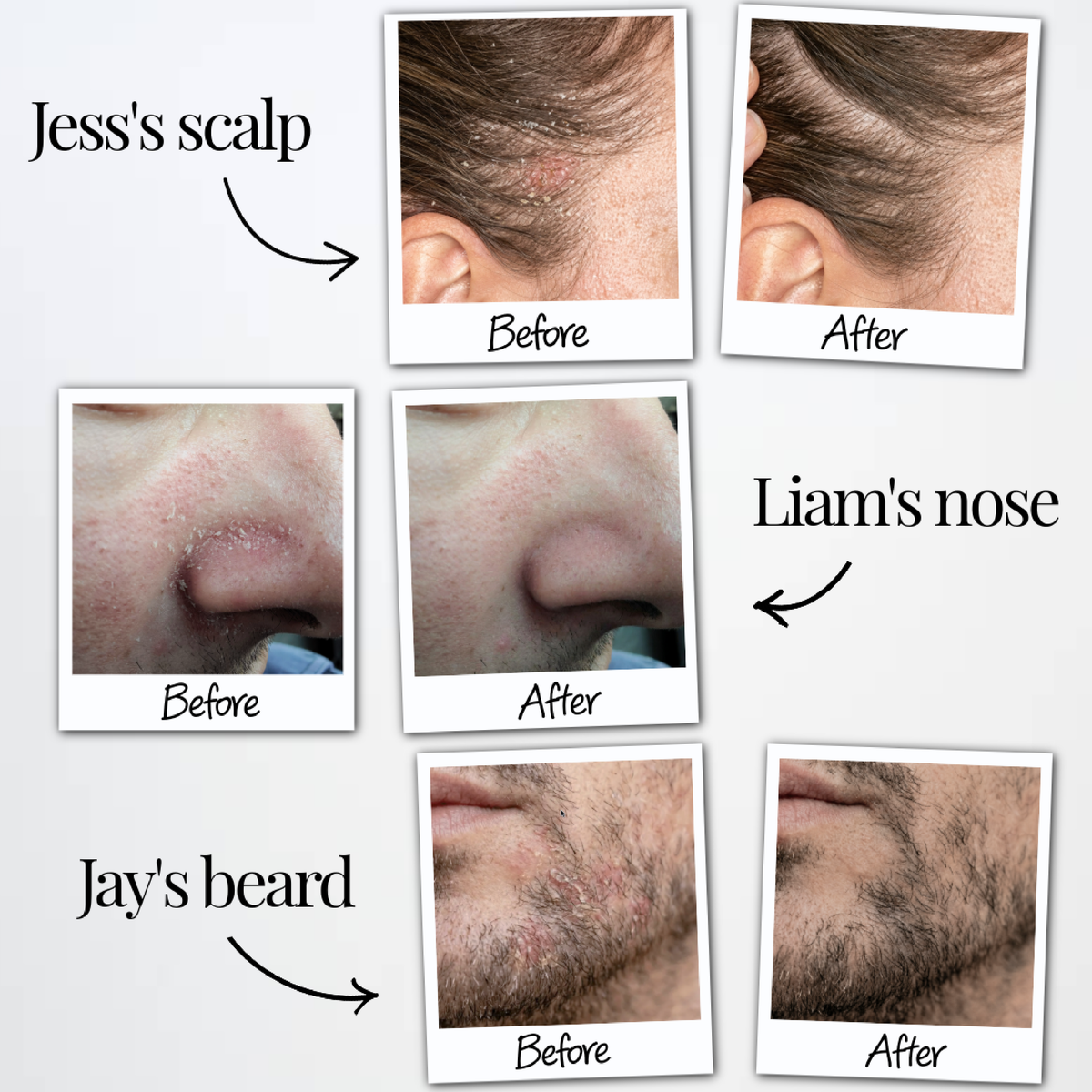
Dandruff is generally limited to the scalp, while seborrheic dermatitis can cause scaling and inflammation on several sebaceous areas of the body.
If you experience persistent scalp flakes alongside redness, itching, greasy scaling or facial symptoms, seborrheic dermatitis may be worth considering.
Managing a Recurring Scalp Condition
The key to understanding recurring dandruff is recognising that it is not necessarily a simple problem of dryness or poor hygiene.
Malassezia, sebum, the skin barrier and individual inflammatory responses can interact to create the conditions in which dandruff and seborrheic dermatitis develop.
Rather than trying to completely eliminate Malassezia, the focus is generally on maintaining a healthy scalp environment and managing the factors that contribute to symptoms.
If your scalp repeatedly flares up, identifying whether you are dealing with simple dandruff, seborrheic dermatitis or another scalp condition is an important first step.
For a more detailed look at symptoms, triggers and management, explore our Seborrheic Dermatitis Guide.